Monday, June 15, 2015

Litter-Arty

In the early 1950s, loads of waste was left over when Chandigarh, designed by Le Corbusier, was built up. A road inspector had a vision of creating art out of the bits and pieces of the litter dump around the city. He created a fantasy, which he called the Rock Garden.
Passages of rock and concrete open out into spaces with human figures studded with tiles and marble. Walls are studded with broken tiles, bathroom fixtures, old crockery and switchgear. Discarded water pots form fences. Whimsy birds fashioned of concrete sit on the roof of a little hut. A waterfall cascades over an open-air theatre paved with broken slate. Turquoise bangles make peacocks. An upturned enamel basin serves as a soldier’s hat! 
The Rock Garden is a legacy that will live even though its creator, Nek Chand Saini is no more! Nek Chand was honoured across the world for his work. While the Indian government conferred the prestigious Padma Shri, the French awarded him the Grande Medaille de Vermeil. His achievement seems more spectacular as he had no formal training in the art of sculpture.
Nek Chand showed that one man’s garbage can be another’s dream. While beauty lies in the eyes of the beholder, some draw out this beauty from what seems to be useless and allow others to see it as well. Nek Chand’s fantasy teaches us that nothing is really litter… and that everything can be turned into a piece of art… when positive vision is backed with proactive action.
Look again... what seems litter is actually art,
Great possibilities awaits our proactive start!
- Pravin K. Sabnis
Goa, India

Monday, June 8, 2015

Imperfect

’You are imperfect, permanently and inevitably flawed. And you are beautiful’.  - Amy Bloom
All of us want to be the best or the second best. Similarly, when we build our team, we seek for perfection. But an obsession with perfection is detrimental. It makes us unable to accept our mistakes, other people’s mistakes and unable to accept untoward events that happen in life.
In ‘Don’t sweat the Small Stuff’; Richard Carlson suggests ‘making peace with imperfection’. A vicious cycle begins when instead of conceding the error; we engulf into guilt and berate ourselves. Otherwise, we refuse ownership of the mistake and enter a state of denial, possibly blaming someone else. Neither of these states is helpful in correcting or preventing the recurrence of the error.
The fact is, we will err, and often we will err repeatedly. We must be patient and calmly note the reasons for the mistake, and simply try to avoid it in the future. Making peace with imperfection extends to others as well. It is unreasonable to expect perfection from our colleagues, particularly given our own lack of perfection.
It is pertinent to note that life is imperfect. Things go wrong. We must learn to accept such things. The world is imperfect, we are imperfect, but that need not stop us from being happy. Happiness comes when we come to terms with our own imperfections and those of others.
Happiness comes from courage to accept…
That like we are.... others too are imperfect!

- Pravin K. Sabnis
Goa, India.

Monday, June 1, 2015

Pointer

Zen philosophy maintains that truth has nothing to do with words. It equates Truth and words to a moon and a finger, respectively. Even if the finger can point to the moon, it is necessary to look beyond the finger to see the moon.
Being fixated with the pointer is pointless. More often than not we spend too much time in analysis of the pointer. We generally get stuck in the validity of concepts and models. Surely it would be better to step out and experience something directly.
The pointer is based on a belief, a perception, an image or a thought process. If the pointer is right, we can see the destination. But if it is incorrect, we have to discard it. Most of the time, our pointer keeps changing depending on the position we are in and our desired destination.
It is more important to connect to real territory. Too often, we allow the pointer to become an addictive restriction. Whether it is our own ego, life purposes or larger community concerns, we must move beyond the pointer and embark on the journey of real experience.
Real experience is the one to refer…
We must look beyond the pointer!

- Pravin K. Sabnis
Goa, India.

Monday, May 25, 2015

LEADERSHIP AUDITION

‘Every time you speak, you are auditioning for leadership’ – James C Humes
James C. Humes wrote speeches for many US Presidents: Eisenhower, Nixon, Ford, Reagan and Bush. His acclaimed books include Instant Eloquence, Podium Humor, The Sir Winston Method, Citizen Shakespeare and The Wit & Wisdom of Winston Churchill. Along with William Safire and Pat Buchanan, Humes is credited for authoring the text on the Apollo 11 lunar plaque.
An expert as well as exponent of the art of speaking, Humes emphasized that the difference between mere management and leadership is communication. He pointed out that the art of communication is the language of leadership. Indeed, we find that leaders stand out due to their ability to speak effectively
 Indeed, every time we have to speak - whether it's in an auditorium, in a conference room, or even across the comfort of our own desk - we are auditioning for leadership. Interestingly, more often than not, speaking is a skill that requires to be just reclaimed. We are born expressive but negative nurturing deteriorates our confidence as well as competency.
To reclaim our ability to speak effectively we must use every opportunity to do so. It is pertinent to note that we first learnt to speak in our childhood by listening to sounds of language. Now, too, we must focus on listening to sounds of various voices (including our own) and apply the learning to every opportunity to speak – whether on the phone, across the table, during a meeting or at the podium.

Rise to every opportunity… stand up to speak
Audition for leadership… reclaim the poise peak!

- Pravin K. Sabnis
Goa, India.

Monday, April 27, 2015

Seize the Day

‘Seize the day’ is a version of the Latin Maxim - Carpe Diem. The term comes from a poem by Horace: ‘carpe diem, quam minimum credula postero’ (Seize the day, put very little trust in tomorrow). The verse indicates that the future is unforeseen and rather than leave things to chance, one should do all one without waiting. The suggestion is to overcome procrastination.
The term ‘procrastination’ comes from the Latin word ‘procrastinatus’, which evolved from the prefix ‘pro’ meaning ‘forward’ and ‘crastinus’ meaning ‘of tomorrow.’ Popularly it implies blameworthy delay due to laziness or apathy. However it is pertinent to note that proactive, dynamic people are often seized by procrastination.
In fact it is positive qualities of well intentioned persons that can result in them finding themselves in a position of procrastination. These qualities include perfectionism, being over analytical, saying ‘Yes’ to every task, multi-tasking and being ‘busy’. But, the real reason is not being able to commit to the real priorities that are revealed only when we connect to our passion and purpose.
Hence, ‘seize the day’ is first, a matter of temperament and then a matter of technique. We must reclaim ownership of our passion and purpose. When we follow our heart, it is easier to break from indecision. We need to sift and prioritise all our commitments, our responsibilities and most importantly the things that will make us happy.
Overcoming Procrastination is not just about doing things at the right time. Rather it is about doing the right things at the right time. Hence ‘seize the day’ is about taking the opportunities to be happy every day by following our passion, pursing a hobby, reconnecting in a relationship, doing little acts of love and doing all that makes us truly contented.
Overcome procrastination... Seize the day!
Our passion and purpose will show the way!

- Pravin K. Sabnis
Goa, India.


Monday, April 20, 2015

MISTAKE

Spencer Silver, a scientist at 3M, stumbled upon glue that did not stick. Most would have considered this to be a mistake, but Silver thought otherwise. He decided to pursue its commercial application. Upon being asked if he had made a mistake, Spencer responded that he had stumbled upon a ‘solution looking for a problem’.
Indeed, it is to 3M's credit that it allowed Silver to carry this strange glue forward. The celebrated Post-it Note pads were invented on the idea of glue that does not stick, and they turned out to be the 3M Corporation's most successful product. This illustrates that quite often we stumble on creative solutions much before we are confronted by yet to come problems.
In today's fiercely competitive world, innovation, though crucial for personal and organic growth, is not easy to sustain. Difficulties arise because most persons and organizations tend to view deviations from institutionalized practices as mistakes that can only detract from overall organizational performance. Yet, to sustain innovation, some deviation is definitely required.
Creativity is all about visioning questions before they get asked. We must see the potential in what may seem to be a mistake. We must develop our tolerance for ambiguity, by seeing the unseen dimensions to a situation that seems a dead-end, but is in reality just a cul-de-sac. We need to consider whether, what appears to be a mistake, is a ‘solution looking for a problem’

Mistakes may be ahead of time solutions
Let’s discover a use to their applications!
- Pravin K. Sabnis
Goa, India.

Monday, April 13, 2015

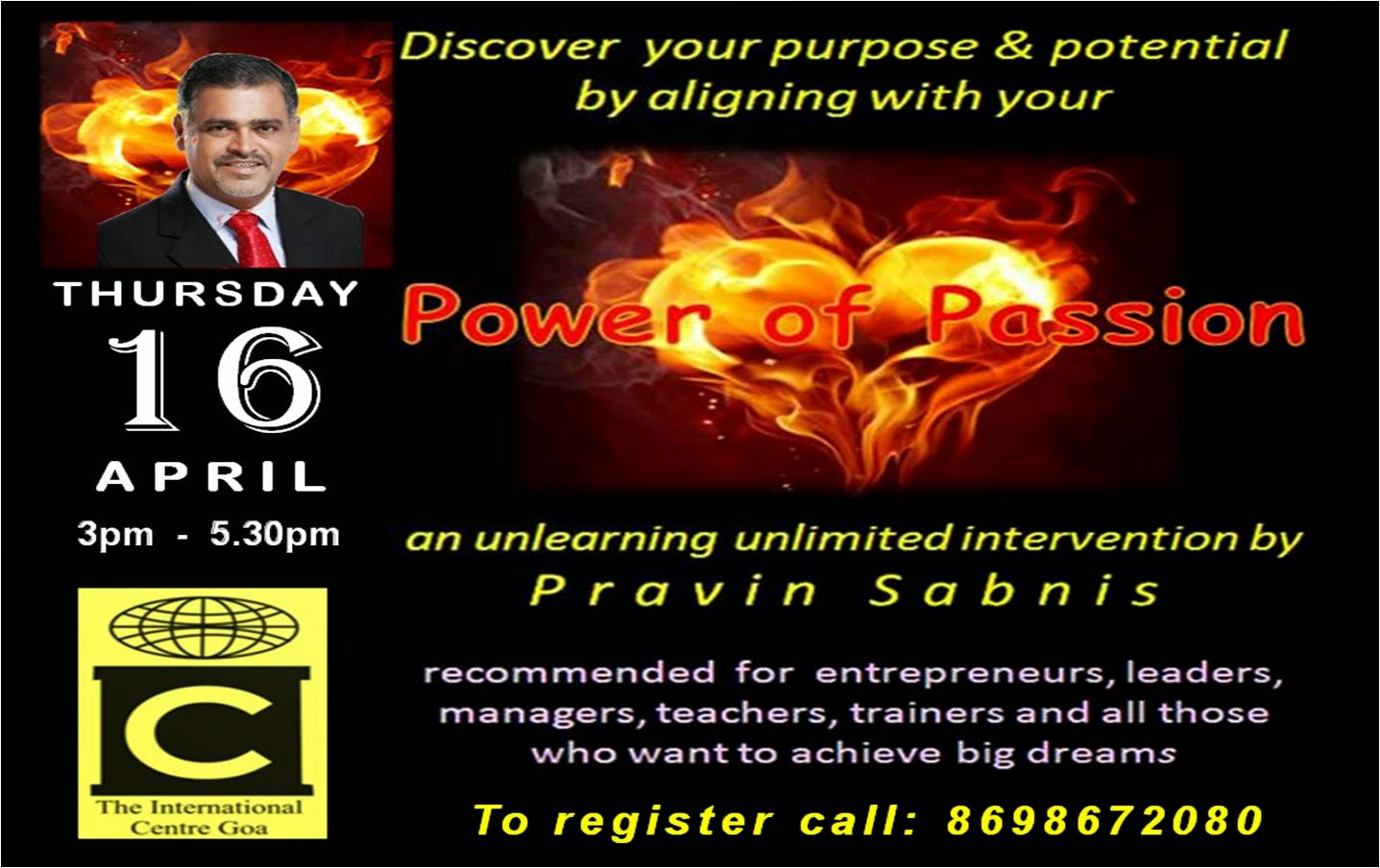
Power of Passion

When my daughter was a little child, my mother would take her to the garden, every evening. On days, when I would join them, I would notice two types of children being escorted to the play area. The first were yet to walk and would be wheeled around in prams. The second types were able to walk and were either held by hand or followed to ensure that they did not run out of sight.
Most prams seemed quite sturdy but the wheels helped move them around easily. The ones who pushed the prams seemed quite in control and were able to easily do other tasks like talk to neighbours or knit sweaters or make phone calls. However, the most flushed were the ones who had children who could run. The guardian was practically pulled along and about all the adult could do was to guide the child in the general direction they wanted it to go.
The analogy is apt for understanding the difference between working and pursing a passion. Working is like pushing the pram. The wheels tell us to push, we can be detached and yet it would remain there. Passion on the other hand is like walking a child. You cannot take your attention away! Passion pulls you along like your child forces you to run behind to keep apace.
That’s the power of passion. When you are doing what you are passionate about, once you get started, the project practically does itself. You get into a focus zone where you see no distractions, you hear no other calls and you feel no other pulls of needs such as food and sleep... Power of passion pulls you to discover your potential and take you to happiness.
So often, so many of us crave for a vehicle – like the baby pram – that can move smoothly and allow us to do other things. However our happiness will be found in discovering our passion that will pull us to the path of true purpose. For this we need to bring our passion from the confines of the comfort zone and allow it to set foot on ground so that it can run... and pull us along!
Let’s step beyond the comfort zone cool...
Life will sprint as power of passion pulls!
- Pravin K. Sabnis
Goa, India.