Monday, May 25, 2015

LEADERSHIP AUDITION

‘Every time you speak, you are auditioning for leadership’ – James C Humes
James C. Humes wrote speeches for many US Presidents: Eisenhower, Nixon, Ford, Reagan and Bush. His acclaimed books include Instant Eloquence, Podium Humor, The Sir Winston Method, Citizen Shakespeare and The Wit & Wisdom of Winston Churchill. Along with William Safire and Pat Buchanan, Humes is credited for authoring the text on the Apollo 11 lunar plaque.
An expert as well as exponent of the art of speaking, Humes emphasized that the difference between mere management and leadership is communication. He pointed out that the art of communication is the language of leadership. Indeed, we find that leaders stand out due to their ability to speak effectively
 Indeed, every time we have to speak - whether it's in an auditorium, in a conference room, or even across the comfort of our own desk - we are auditioning for leadership. Interestingly, more often than not, speaking is a skill that requires to be just reclaimed. We are born expressive but negative nurturing deteriorates our confidence as well as competency.
To reclaim our ability to speak effectively we must use every opportunity to do so. It is pertinent to note that we first learnt to speak in our childhood by listening to sounds of language. Now, too, we must focus on listening to sounds of various voices (including our own) and apply the learning to every opportunity to speak – whether on the phone, across the table, during a meeting or at the podium.

Rise to every opportunity… stand up to speak
Audition for leadership… reclaim the poise peak!

- Pravin K. Sabnis
Goa, India.

Monday, April 27, 2015

Seize the Day

‘Seize the day’ is a version of the Latin Maxim - Carpe Diem. The term comes from a poem by Horace: ‘carpe diem, quam minimum credula postero’ (Seize the day, put very little trust in tomorrow). The verse indicates that the future is unforeseen and rather than leave things to chance, one should do all one without waiting. The suggestion is to overcome procrastination.
The term ‘procrastination’ comes from the Latin word ‘procrastinatus’, which evolved from the prefix ‘pro’ meaning ‘forward’ and ‘crastinus’ meaning ‘of tomorrow.’ Popularly it implies blameworthy delay due to laziness or apathy. However it is pertinent to note that proactive, dynamic people are often seized by procrastination.
In fact it is positive qualities of well intentioned persons that can result in them finding themselves in a position of procrastination. These qualities include perfectionism, being over analytical, saying ‘Yes’ to every task, multi-tasking and being ‘busy’. But, the real reason is not being able to commit to the real priorities that are revealed only when we connect to our passion and purpose.
Hence, ‘seize the day’ is first, a matter of temperament and then a matter of technique. We must reclaim ownership of our passion and purpose. When we follow our heart, it is easier to break from indecision. We need to sift and prioritise all our commitments, our responsibilities and most importantly the things that will make us happy.
Overcoming Procrastination is not just about doing things at the right time. Rather it is about doing the right things at the right time. Hence ‘seize the day’ is about taking the opportunities to be happy every day by following our passion, pursing a hobby, reconnecting in a relationship, doing little acts of love and doing all that makes us truly contented.
Overcome procrastination... Seize the day!
Our passion and purpose will show the way!

- Pravin K. Sabnis
Goa, India.


Monday, April 20, 2015

MISTAKE

Spencer Silver, a scientist at 3M, stumbled upon glue that did not stick. Most would have considered this to be a mistake, but Silver thought otherwise. He decided to pursue its commercial application. Upon being asked if he had made a mistake, Spencer responded that he had stumbled upon a ‘solution looking for a problem’.
Indeed, it is to 3M's credit that it allowed Silver to carry this strange glue forward. The celebrated Post-it Note pads were invented on the idea of glue that does not stick, and they turned out to be the 3M Corporation's most successful product. This illustrates that quite often we stumble on creative solutions much before we are confronted by yet to come problems.
In today's fiercely competitive world, innovation, though crucial for personal and organic growth, is not easy to sustain. Difficulties arise because most persons and organizations tend to view deviations from institutionalized practices as mistakes that can only detract from overall organizational performance. Yet, to sustain innovation, some deviation is definitely required.
Creativity is all about visioning questions before they get asked. We must see the potential in what may seem to be a mistake. We must develop our tolerance for ambiguity, by seeing the unseen dimensions to a situation that seems a dead-end, but is in reality just a cul-de-sac. We need to consider whether, what appears to be a mistake, is a ‘solution looking for a problem’

Mistakes may be ahead of time solutions
Let’s discover a use to their applications!
- Pravin K. Sabnis
Goa, India.

Monday, April 13, 2015

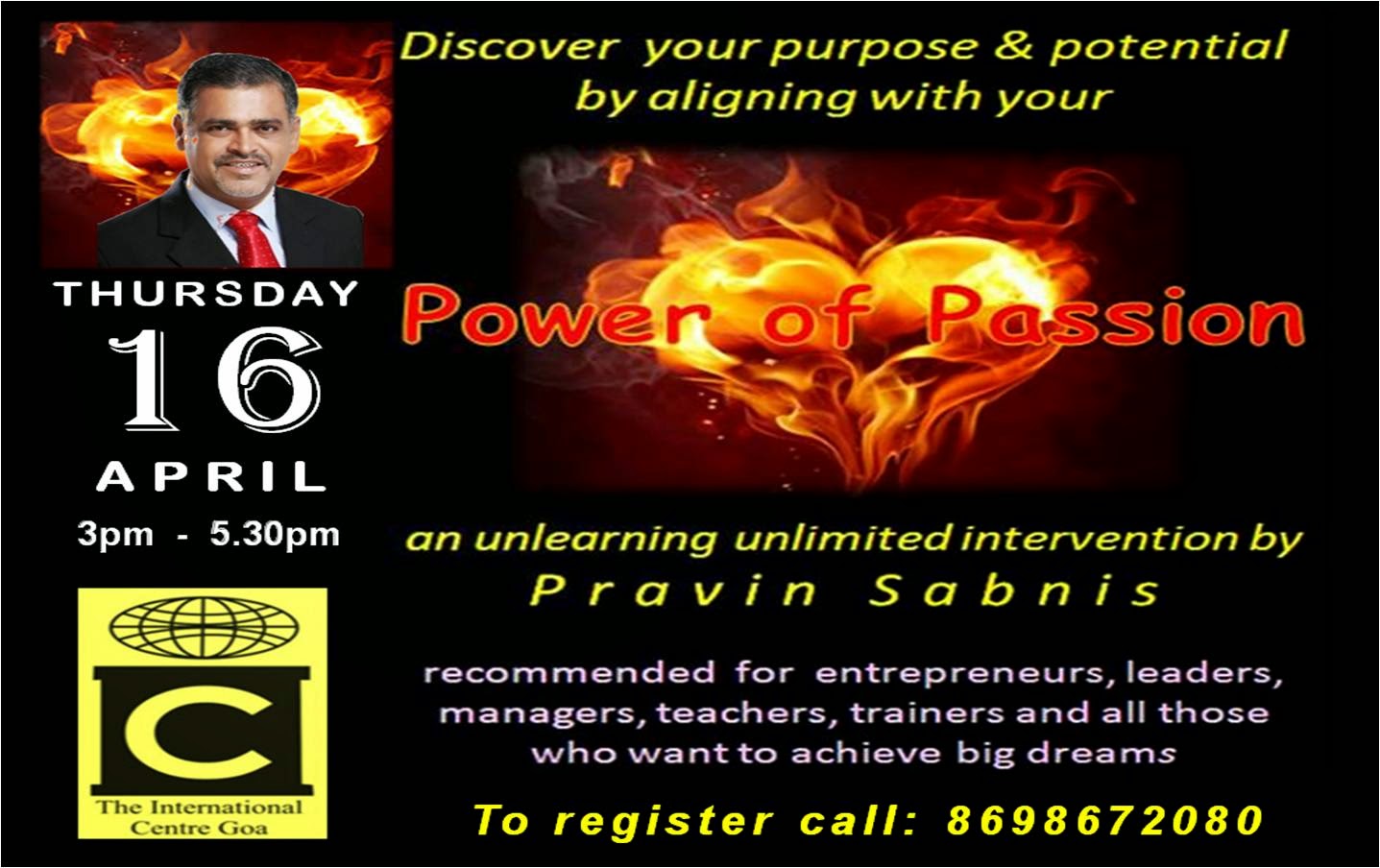
Power of Passion

When my daughter was a little child, my mother would take her to the garden, every evening. On days, when I would join them, I would notice two types of children being escorted to the play area. The first were yet to walk and would be wheeled around in prams. The second types were able to walk and were either held by hand or followed to ensure that they did not run out of sight.
Most prams seemed quite sturdy but the wheels helped move them around easily. The ones who pushed the prams seemed quite in control and were able to easily do other tasks like talk to neighbours or knit sweaters or make phone calls. However, the most flushed were the ones who had children who could run. The guardian was practically pulled along and about all the adult could do was to guide the child in the general direction they wanted it to go.
The analogy is apt for understanding the difference between working and pursing a passion. Working is like pushing the pram. The wheels tell us to push, we can be detached and yet it would remain there. Passion on the other hand is like walking a child. You cannot take your attention away! Passion pulls you along like your child forces you to run behind to keep apace.
That’s the power of passion. When you are doing what you are passionate about, once you get started, the project practically does itself. You get into a focus zone where you see no distractions, you hear no other calls and you feel no other pulls of needs such as food and sleep... Power of passion pulls you to discover your potential and take you to happiness.
So often, so many of us crave for a vehicle – like the baby pram – that can move smoothly and allow us to do other things. However our happiness will be found in discovering our passion that will pull us to the path of true purpose. For this we need to bring our passion from the confines of the comfort zone and allow it to set foot on ground so that it can run... and pull us along!
Let’s step beyond the comfort zone cool...
Life will sprint as power of passion pulls!
- Pravin K. Sabnis
Goa, India.

Monday, April 6, 2015

Impermanence


‘All is flux, nothing remains still!’ – Heraclitus, Greek philosopher

Change is the only constant. This is true at all levels. Stars form and collapse. Continents shift. Seasons change. Our body decays, the mind evolves and relationships change. But it is pertinent to note that though we live in a world of constant flux, many of us refuse to recognize it and distress is the result.

When we fail to accept impermanence, we cling to things. We cling to days gone by, to relationships and to possessions. We cling to them as if they will provide lasting happiness. Eventually, reality intervenes. When that, what we cling to, is taken from us, we face the reality of impermanence. Thus we feel the pain of a lost car, of a failing relationship or the death of a loved one.

Remarkably, the pain arises even before the loss, in the form of fear. Though we know it is temporary, we live in fear of losing it. We can have a much better off life if we realize and accept the fact of flux. We can learn to appreciate things we have but without staking our happiness on them. This helps to make better decisions. When we know that we will change and that other people will change, then we can identify the fresh approach that’s needed.

The unhappiness that comes from clinging to impermanence is a harsh reality. Admitting the impermanence may seem daunting, however it is actually liberating. In reality, we are just conceding something that we already know. When we bring it into the open, it is not so scary. We find that recognition of impermanence brings lightness, acceptance and bliss into our lives.

Clinging is just hurtful dependence
Learn to let go of impermanence!

- Pravin K. Sabnis
Goa, India.


Monday, March 30, 2015

Make it Large

A young man approached a Zen master to find solution to his unhappiness.  The sage told him to put a handful of salt in a glass of water and then drink it. The young man immediately spat it out. The sage then asked him to take another handful of salt and put it in a lake and told him to drink the water. The young man did not find it repulsive now.

The teacher shared a profound truth to the troubled learner: ‘the pain of life is akin to salt. But the intensity we taste as 'pain' depends on the container we put it into. So when you are in pain, the only thing you can do is to enlarge your sense of things... Stop being a small glass, become a large lake!’

So often, so many of us find ourselves in pain or hurt or failure. We feel let down by a person or the situation. We cast ourselves as victims as our unhappiness arises from a feeling of futility. And since we see the situation through a narrow cone, the intensity of the hurting gets magnified.

Now, imagine seeing that person or that situation from a perspective of a longer timeline. We may be playing blind to the larger picture and focussing only on the exception. It is pertinent to note that a timeline dilutes the intensity of pain. Similarly when we see a singular negative experience in context of a larger set of experiences, our interpretation tends to alter.

We must allow every emotion to move beyond victimhood reactions. We must see every person, every action and every situation from the larger perspective of a longer timeline. This is not to dilute the reality of the person or the action or the situation; but it will certainly dilute the intensity of pain and empower our response to cope with that person or that action or that situation.

Make it large... a perspective that’s sane...
The lake, not the glass, will ease the pain!

- Pravin K. Sabnis
Goa, India.

Monday, March 23, 2015

Purpose

In the 1940s, an Austrian existential psychologist, Viktor Frankl was held captive in a Nazi concentration camp. His family, friends, and neighbours were captured too. Viktor lived the horror of losing everything to torture and terror. Despite the brutality, Viktor never gave up his relentless fight for his life.

He found meaning in his struggle, and that gave him the power to push ahead through unimaginable pain. After escaping, Viktor wrote a book called ‘Man’s Search for Meaning’, which chronicles his experiences. A quote by Nietzsche sums up his philosophy on how people were able to survive the camps, without losing the will to live: ‘He who has a why to live for can bear almost any how.’

Our reactions are not solely the result of the conditions of our life. They arise also from the freedom of choice we always have even in severe suffering. Viktor wrote, ‘In some way, suffering ceases to be suffering at the moment it finds a meaning, such as the meaning of a sacrifice.’ But he cautioned ‘of getting stuck in suffering mode and mistaking it for nobility.’ He wrote, ‘Suffering unnecessarily is masochistic rather than heroic.’

Viktor underlined the power of purpose. Purpose is what gives us the strength to carry on, if not through dire conditions, then through difficult changes, transitions, relationships, and activities. Viktor concludes from his experience that the meaning of life is found in every moment of living; life never ceases to have meaning, even in suffering and death.

On this very day that Bhagat Singh died at the age of 23. Alexander died at the age of 32 years. Mozart died at the age of 35. Swami Vivekananda died at the age of 39. They were able to live worthwhile lives, despite dying young because they were able to find and fulfil their purpose in life. Robert Byrne has said it so well: ‘The purpose of life is a life of purpose’

Let’s find purpose in life and live it now
Live life with meaning before the bow!

- Pravin K. Sabnis
Goa, India.